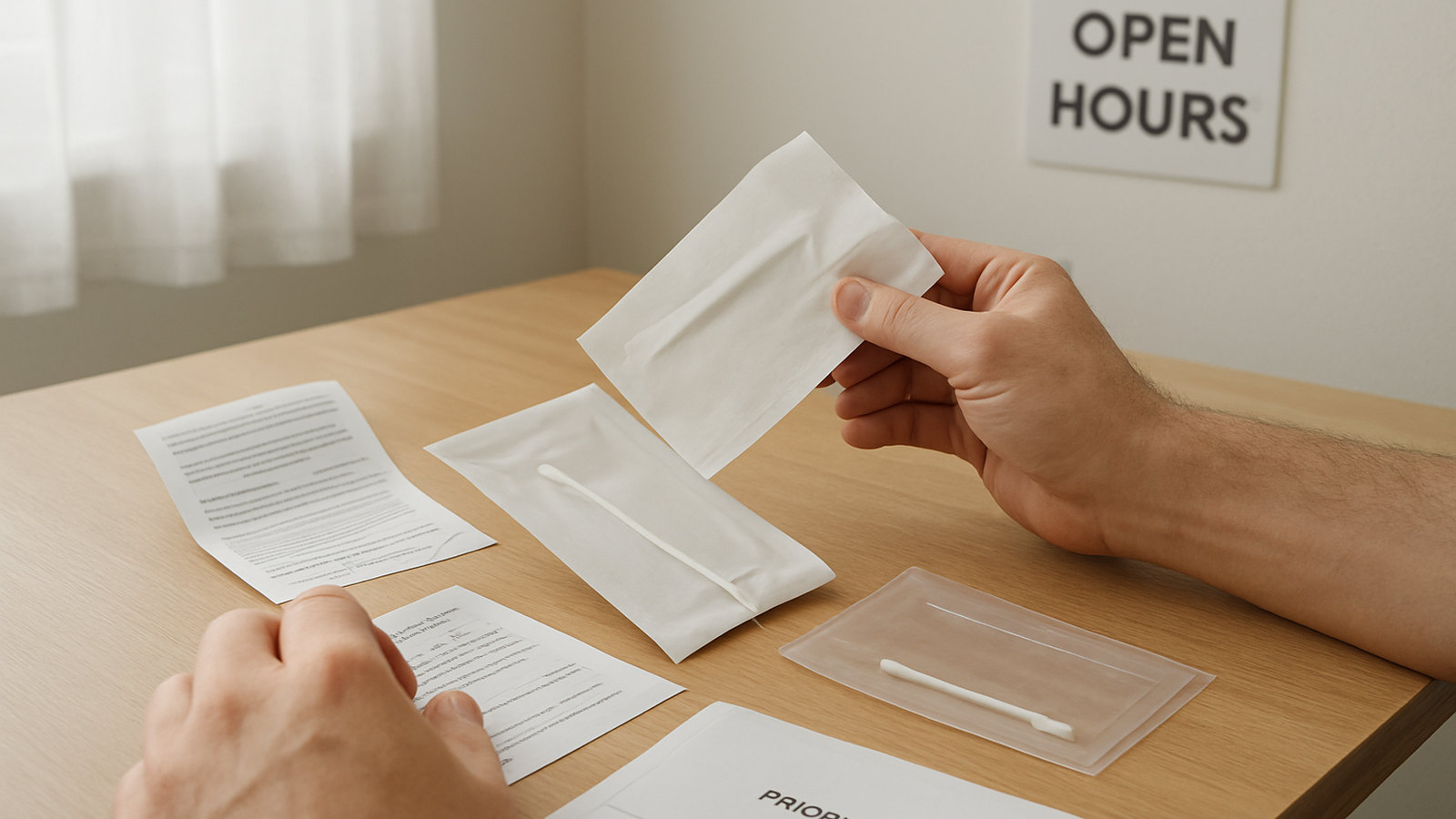
Free postal testing has changed how most people in the UK screen. Services commissioned by local authorities, of which SH:24 is the largest, send a kit through the post, you take the samples at home, post them back in a prepaid envelope and get results by text within a few days. The tests themselves are processed in the same accredited NHS laboratories that handle clinic samples, so the accuracy question has a straightforward answer: they are as good as the tests you would get in person.
What does a kit include?
A standard kit covers chlamydia and gonorrhoea and includes a finger-prick blood sample for HIV and syphilis. Crucially, you can request rectal and throat swabs as well, and you should, because a urine-only kit will miss most infections if you have receptive anal sex or give oral sex. The ordering form asks about the sex you have, and answering it accurately is what determines which swabs arrive in the box.
Where does the accuracy actually vary?
Not in the laboratory but in the sampling. A poorly taken swab or an inadequate blood sample is the main failure point, and the commonest problem is not filling the blood tube. Finger-prick collection takes patience: warm your hands under hot water first, keep the arm below heart level, and use the second or third drop rather than squeezing hard, which contaminates the sample with tissue fluid. If the laboratory cannot process it you will be asked to repeat, which costs a week.
When is a clinic the better choice?
Postal kits are for screening when you have no symptoms. Go to a clinic instead if you have discharge, an ulcer, a lump, rectal pain or burning when you urinate, because those need examining and often treating the same day. Go to a clinic if you may have been exposed to HIV in the past seventy-two hours, because that is a PEP conversation and PEP cannot be posted. Go to a clinic if you need vaccination, if you want to start PrEP, or if you have had a positive result and need treatment, since almost all treatment requires an in-person visit and gonorrhoea specifically requires an injection.
Does it stay private?
Kits arrive in plain packaging without any branding suggesting the contents. Results come by text or through a secure online account. Nothing goes to your GP unless you ask for it or a positive HIV result triggers a conversation about onward care. You choose the delivery address, so a work address or a friend's address is an option if the household situation makes home difficult.
What about the tests you can buy in a pharmacy?
Rapid HIV self-tests sold over the counter are a different product. They detect antibodies only, which means a ninety-day window rather than forty-five, and a reactive result always needs confirming with a laboratory test. They are useful for people who will not otherwise test at all, but a free postal kit that sends a real blood sample to a laboratory is a better screen for most people, and it costs nothing.
How do you order one?
Search for your local authority sexual health service, which will link to whichever provider is commissioned in your area, or go directly to a national free HIV testing service. Availability and what is included vary by postcode, which is frustrating but does mean it is worth checking your own area rather than assuming a friend's experience applies.
Using them well
Order on a fixed schedule rather than after a scare, take every swab the kit offers rather than only the ones that feel relevant, and post it back the same day where possible since samples degrade in a hallway. A postal kit every three months, with clinic visits reserved for symptoms, vaccinations and PrEP reviews, is a realistic pattern that most people can actually sustain.
What if the result is positive?
The service contacts you by phone and arranges treatment, usually by referring you to a local clinic. Gonorrhoea requires an intramuscular injection so it cannot be handled remotely, while chlamydia can sometimes be treated with a prescription collected from a pharmacy. Answer the call, because a positive postal result that is never acted on is worse than not testing, and services do give up chasing eventually.