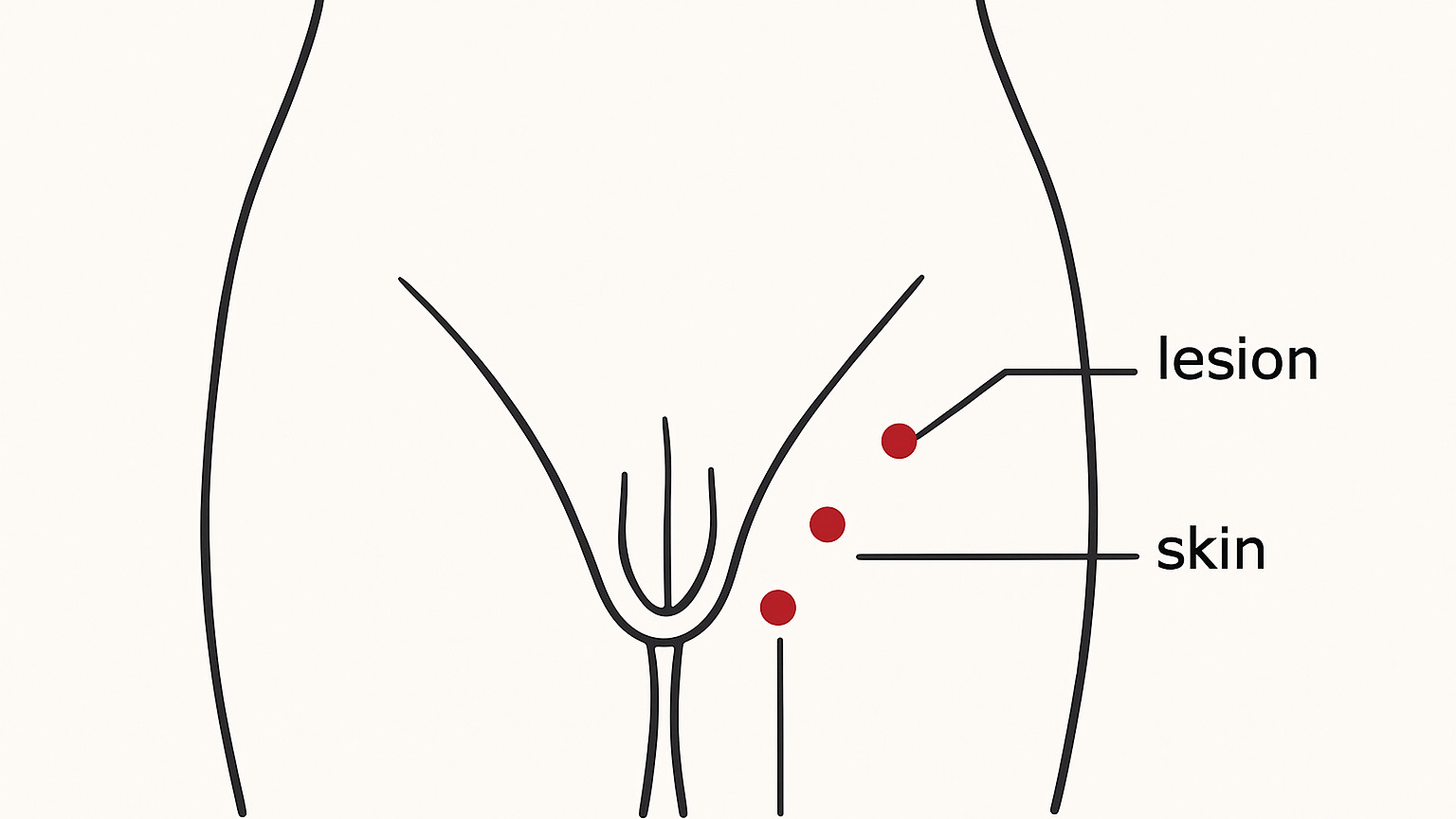
The version of mpox that has circulated in sexual networks since 2022 does not always follow the sequence described in older textbooks. The classical description is fever and swollen glands for a few days followed by a rash that spreads across the body. What clinicians have seen far more often is a small number of lesions appearing first in the anogenital area or around the mouth, with fever either mild, delayed or absent altogether.
What does a lesion look like?
Individual lesions move through a recognisable sequence. They start as a flat red mark, become a raised firm bump, then fill with clear fluid, then with pus, giving a pale or yellowish centre that is often described as looking like a deep spot with a dimple in it. They then crust over and the scab eventually falls away, sometimes leaving a scar. The whole progression for a single lesion takes roughly two to four weeks.
How many lesions should you expect?
Far fewer than the word rash suggests. Many people have had a handful, and some only one. A single firm, deep-looking spot on the shaft of the penis, on the scrotum, around the anus, on the face or inside the mouth has been a common presentation. The lesions tend to be firm and deeply seated rather than superficial, and are frequently painful, particularly anogenital ones.
What else comes with it?
Swollen lymph nodes are a genuinely useful sign, since they help separate mpox from chickenpox and herpes, and are often prominent in the groin, neck or armpit. Fever, chills, headache, muscle aches, backache and pronounced fatigue can precede, accompany or follow the lesions. Sore throat and, importantly, proctitis are common: severe rectal pain, discharge and tenesmus have been a frequent and sometimes dominant feature, occasionally with no visible external lesions at all.
How long after exposure does it start?
The incubation period is usually five to twenty-one days, most commonly around a week. That is a long window compared with bacterial infections, and it means the relevant contact may not be the most recent one.
How do you distinguish it from herpes or syphilis?
Not reliably by eye, which is why swabbing matters. Herpes lesions are more superficial, tend to come in clusters of small blisters on a red base and are usually softer. A syphilis chancre is characteristically painless and solitary with a firm clean base. Mpox lesions are firmer, deeper, umbilicated at the centre, may be scattered across separate body areas, and are usually accompanied by lymph node swelling. A clinician will swab the lesion regardless, because these conditions can and do coexist.
What should you do if you suspect it?
Do not walk into a busy clinic unannounced. Ring the sexual health clinic first and describe what you are seeing so they can arrange for you to be seen in a way that limits contact with others. Cover the lesions where practical, avoid sex and close skin to skin contact, and avoid sharing towels or bedding until you have been assessed. Most cases are managed at home with pain relief, though severe proctitis and lesions in the mouth or eye sometimes need hospital care.
How infectious is it and for how long?
Transmission is primarily through prolonged close skin to skin contact, which is why sex is such an efficient route. Contaminated bedding, towels and sex toys can also transmit it. You remain infectious until every lesion has crusted, the scabs have fallen off and fresh skin has formed underneath, which typically takes two to four weeks. That period requires patience rather than judgement about when you feel better.
Is there a vaccine?
Yes. The MVA vaccine is offered free through UK sexual health clinics to men who have sex with men at higher risk, including anyone with multiple partners, group sex or a recent bacterial STI. It is a two-dose course and offers substantial though not complete protection. If you have not had both doses, a clinic appointment is worth booking regardless of whether you currently have symptoms.