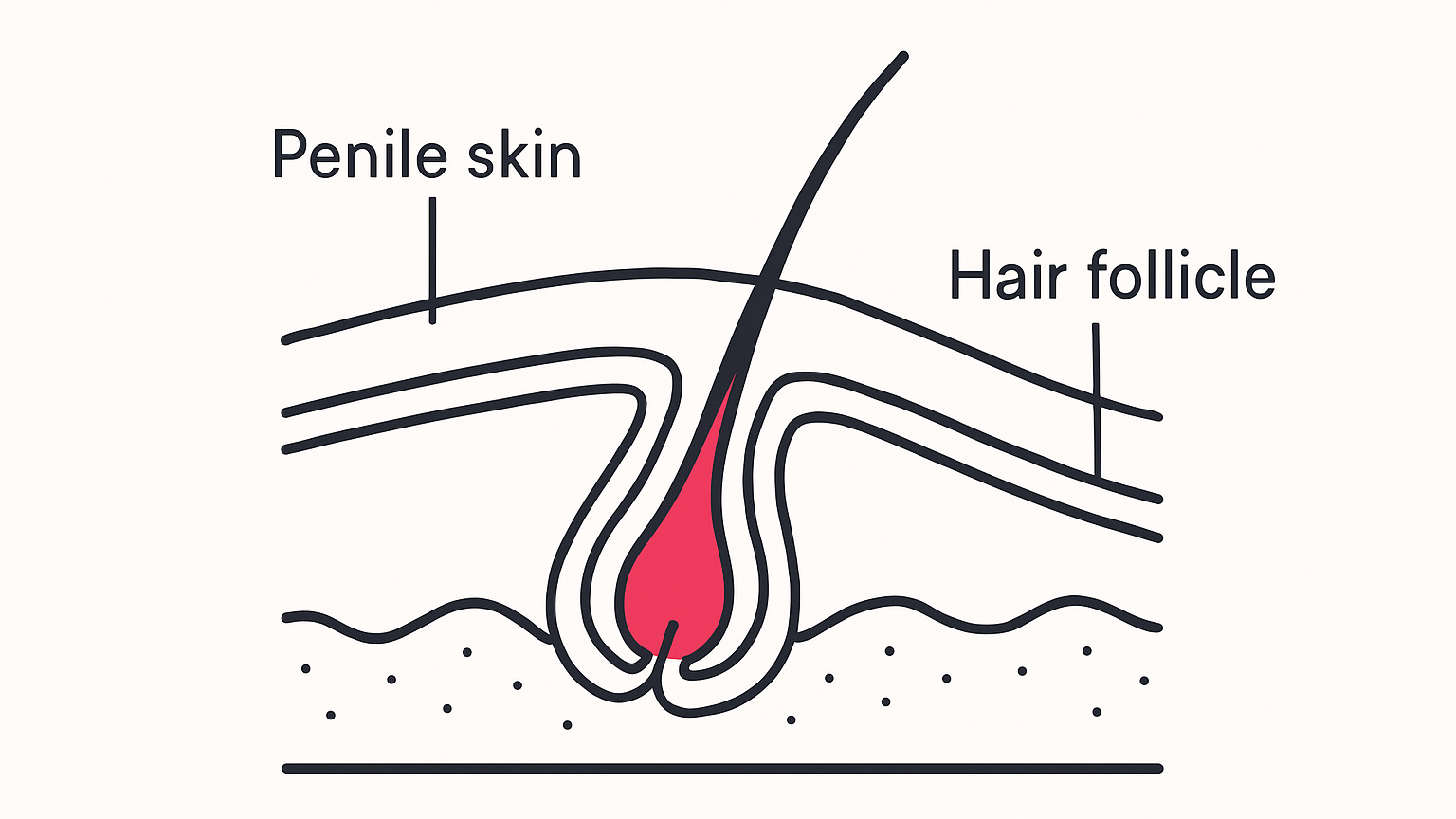
Finding a lump anywhere on the genitals reliably produces a bad evening. In most cases the explanation is unremarkable: normal anatomy that has always been there and only now been noticed, or a blocked hair follicle. A minority are sexually transmitted infections, and a small number are things that need seeing promptly. The useful distinctions are whether it has changed, whether it hurts, and whether there is one or many.
Which lumps are completely normal?
Pearly penile papules are small skin-coloured bumps arranged in one or two neat rows around the rim of the glans. They are present in a large proportion of men, are not infectious, and never need treating. Fordyce spots are small pale yellow or white bumps on the shaft or scrotum, which are simply visible oil glands. Tyson glands sit either side of the frenulum. Skin tags occur in the groin as they do elsewhere. The common feature of all of these is that they do not change. Anything that has looked the same for years and does not hurt is almost certainly anatomy.
What are genital warts?
Warts caused by HPV are the most common lump that is genuinely sexually transmitted. They are usually soft, skin-coloured or slightly darker, and can be flat, raised or have a rough cauliflower-like surface. They appear singly or in clusters on the shaft, under the foreskin, around the anus or in the pubic area, are painless, and may itch mildly. They can take weeks to over a year to appear after exposure, which makes tracing the source largely pointless. They are treatable at a sexual health clinic with freezing or a prescribed cream, and the HPV vaccine offered free to men who have sex with men prevents the strains responsible.
What about molluscum contagiosum?
Molluscum produces small, firm, dome-shaped bumps with a characteristic dimple in the centre, usually pearly and only a few millimetres across. It is a viral skin infection spread by skin to skin contact, is harmless, and clears on its own over months. Clinics can treat it if the appearance bothers you.
When does a lump suggest something needing prompt treatment?
A single painless ulcer or firm sore with a clean base is the classic syphilis chancre and needs testing regardless of how unbothered you are by it, because it will heal by itself while the infection continues. Painful clustered blisters or ulcers suggest herpes and should be swabbed while visible. A firm, deep lesion with a dimpled pale centre, especially with swollen glands, raises the question of mpox. A hot, red, exquisitely tender lump that is growing over a day or two is more likely an abscess and needs draining rather than antibiotics alone.
What does a lump in the groin itself mean?
Lumps in the groin crease are usually lymph nodes, which swell in response to infection anywhere in the genital area, legs or feet. Tender, mobile, pea-sized nodes on both sides are a common and non-specific response. Nodes that are very large, matted together, or accompanied by rectal symptoms raise the possibility of lymphogranuloma venereum. Hard, painless, progressively enlarging nodes that do not settle need investigating for causes unrelated to sexual health. A soft bulge that appears on straining and disappears when you lie down is likely a hernia and belongs with a GP.
What about lumps in the testicle?
This is the category that should never be left. A painless lump within the body of the testicle itself needs a same-week GP appointment, because testicular cancer is most common in exactly the age group reading this and is highly curable when caught early. Sudden severe testicular pain is an emergency the same day. A soft swelling above and behind the testicle is more often an epididymal cyst or varicocele, but it still needs someone to examine it and say so.
What should you do?
If it is new, changing, painful or ulcerated, book a sexual health clinic appointment and let someone look at it. Resist the urge to squeeze, cut or treat it with anything from a chemist aimed at warts elsewhere on the body. Photographs taken while it is at its worst are genuinely useful if it settles before your appointment.