
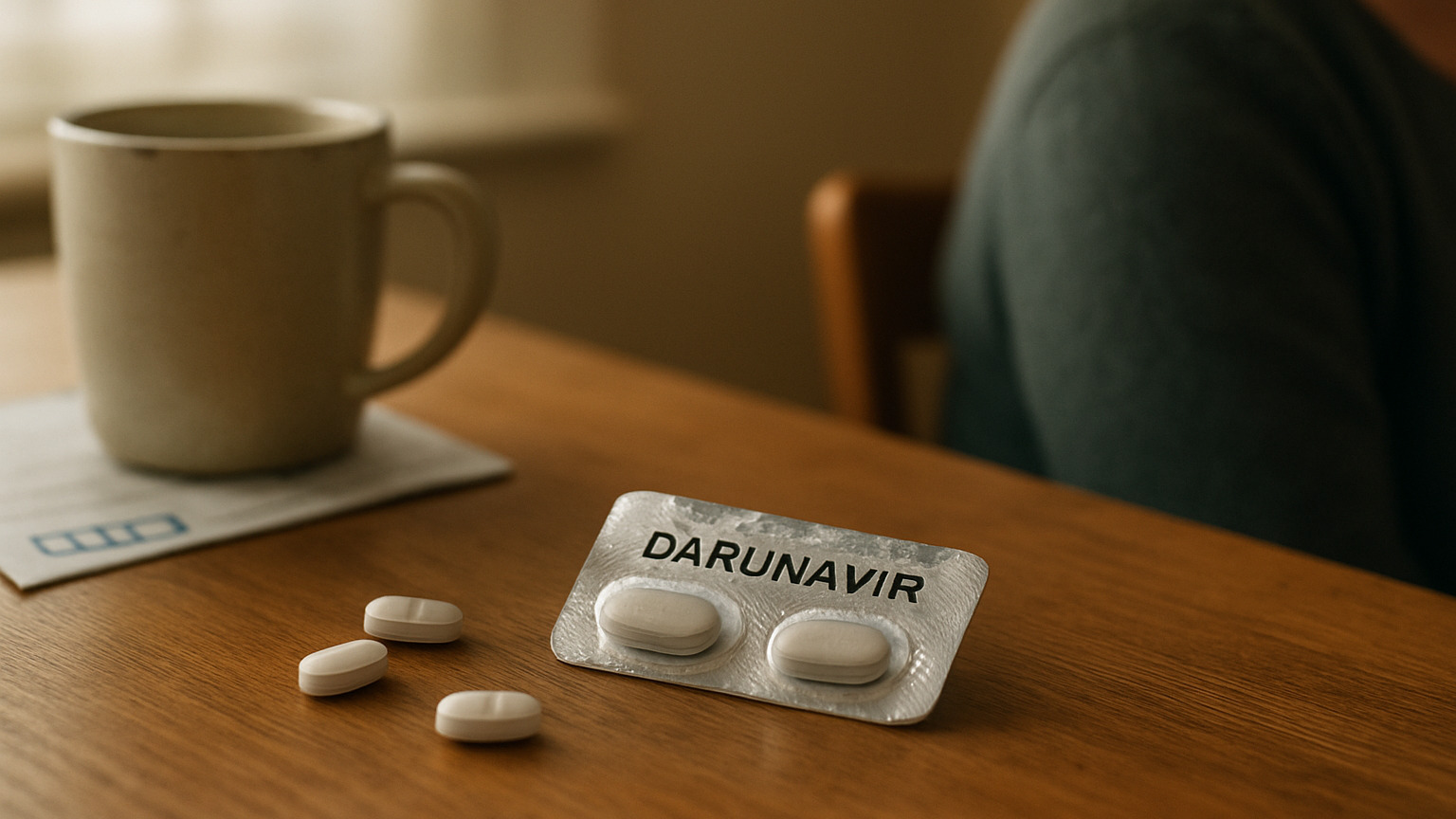
Darunavir is a protease inhibitor used in combination HIV treatment. Its defining property is an unusually high barrier to resistance, which makes it the option of choice in several specific situations.
What kind of drug is it?
A protease inhibitor, from the class that transformed HIV treatment in the mid-1990s. It was designed later than the others in the class, specifically to remain effective against virus that had already defeated them.
How does it work?
HIV manufactures its proteins as long chains that must be cut into functional pieces before a new virus particle can mature. The enzyme that does the cutting is protease. Darunavir binds to it and blocks it.
What happens then?
New particles are still assembled and released, and they are immature and non-infectious. The proteins inside remain as uncut chains that cannot form a working virus, so the infection cannot spread to further cells.
Why does it need a booster?
Because the liver clears it quickly enough that impractical doses would otherwise be needed. A booster, either ritonavir or cobicistat, blocks the responsible enzyme and allows once-daily dosing. The booster has no antiviral activity of its own.
What makes its resistance barrier so high?
It binds to the protease enzyme unusually tightly and at more than one point, so a single mutation is rarely enough to displace it. Several mutations must accumulate before activity is meaningfully lost, which takes time and repeated exposure.
Why does that matter practically?
Because it means darunavir tolerates imperfect adherence better than most antiretrovirals. Where someone's dosing is likely to be irregular, or where the consequences of resistance would be severe, that robustness is worth a good deal.
What is it used for?
HIV treatment as part of a combination. It is used for people starting treatment, for people switching, for people with existing drug resistance, and in some post-exposure prophylaxis regimens.
How does it compare with atazanavir?
Higher resistance barrier, no jaundice, and no dependence on stomach acid, which removes the interaction with indigestion medicines. Against that, it carries a sulfonamide component and a rash risk, and lipid effects are broadly similar.
How does it compare with integrase inhibitors?
Integrase inhibitors are first-line in current UK practice because they are better tolerated, suppress faster and need no booster. Darunavir retains a place where resistance or adherence considerations favour its robustness.
Is it available generically?
Yes, which has reduced its cost considerably, and it is also available in co-formulated products.
Where does it sit against the alternatives?
No antiretroviral is best in every situation. Darunavir's case rests on robustness rather than convenience, and the fit depends on your resistance history, your other medicines and how consistent your dosing realistically is.
Is it a lifelong medicine?
HIV treatment is taken indefinitely rather than for a course, because stopping allows the virus to rebound within weeks. What people take does change over the years, as better options appear and as circumstances shift, so being on darunavir now does not mean being on it forever.
Does it work if you take it properly?
For the great majority of people, yes. Modern combinations containing darunavir achieve an undetectable viral load in most people who take them consistently, and once suppression is sustained, HIV is not passed on sexually.
Who chooses your regimen?
A clinician, with you. The clinical constraints are fixed and within them your preferences are legitimate: tablet size, dosing schedule, side effects you would rather not have, and how a regimen fits the way you actually live.
What should you ask at the start?
What this regimen requires of you daily, what side effects are common in the first month, what to do about a missed dose, and what the alternatives would be if it does not suit. Asking those four things at the outset saves a good deal later.
Is there anything to do before starting?
Baseline blood tests covering kidney and liver function, lipids and viral load, plus hepatitis B and C status and a resistance test. These take a few days and they determine whether darunavir is the right choice rather than being a formality.


