
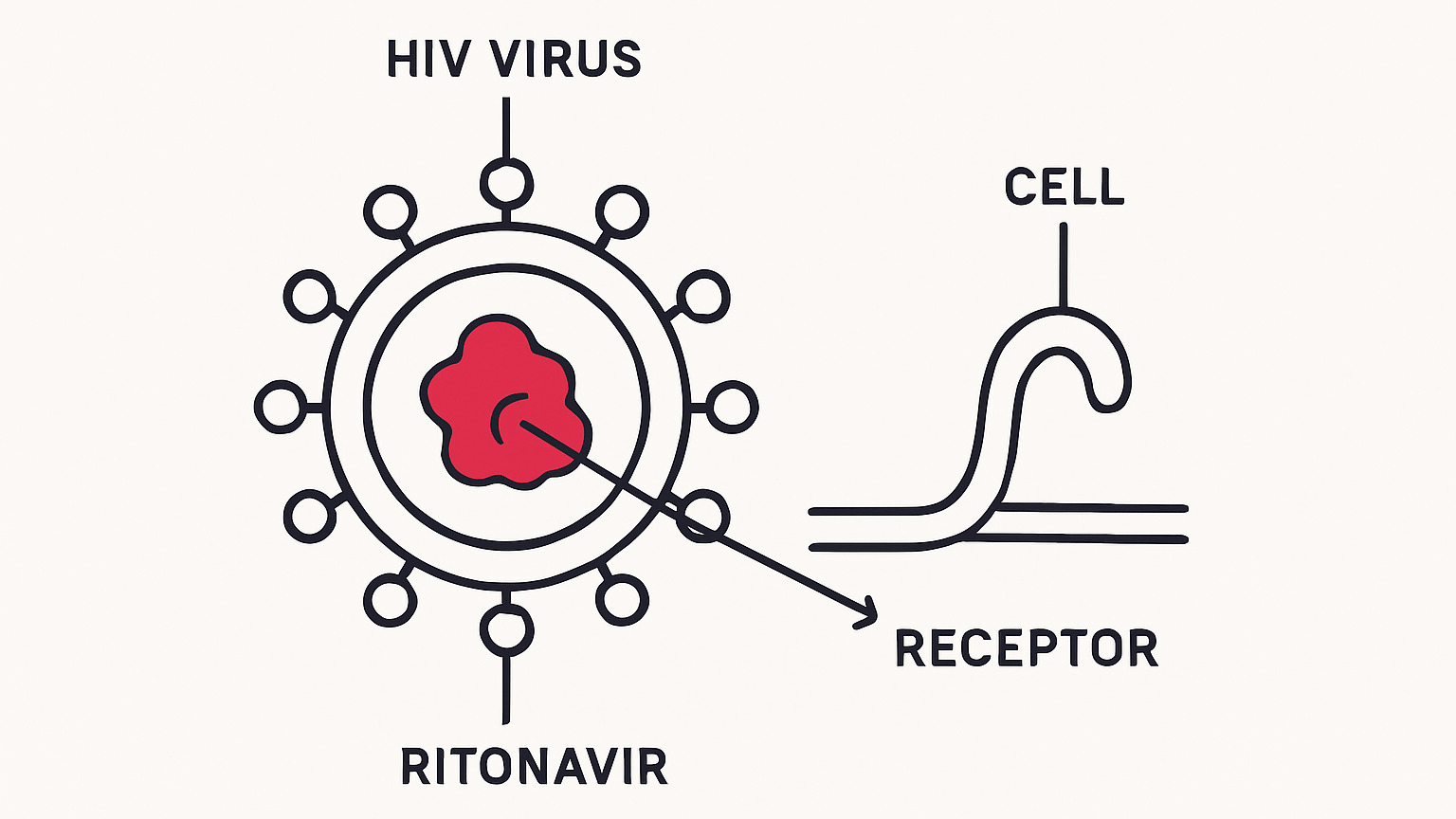
Ritonavir's research history is unusual: the trials that established it as an antiviral matter far less than the observation that it changed how other drugs behaved.
What did the original trials show?
Ritonavir at full antiviral dose improved survival and reduced progression in advanced HIV disease, in studies conducted before combination therapy was standard. Those results were genuinely important at the time.
Why is it no longer used that way?
Tolerability. At 600mg twice daily it caused substantial nausea, vomiting, diarrhoea and disturbances of taste and sensation. People struggled to stay on it, and better tolerated protease inhibitors arrived.
How was boosting discovered?
Through pharmacokinetic observation. Researchers noted that ritonavir dramatically raised levels of other protease inhibitors given alongside it, by inhibiting the enzyme that cleared them. Low-dose ritonavir was then studied deliberately for that purpose.
What did boosting achieve?
Studies of boosted regimens showed higher and more sustained drug levels, allowing less frequent dosing, better adherence and better virological outcomes. It transformed a difficult class into a practical one.
How does it compare with cobicistat?
Direct comparisons found equivalent boosting and equivalent viral outcomes. Cobicistat was generally better tolerated with less nausea and no taste disturbance, and discontinuation was lower in some studies.
What about the interaction burden?
Studies of individual interactions consistently show the two boosters producing similar effects on other medicines. Ritonavir additionally induces some enzymes, which makes its behaviour somewhat harder to predict.
What about pregnancy?
Studies have shown boosted drug levels falling during pregnancy with both boosters, and the fall has been more problematic with cobicistat. Ritonavir is therefore generally preferred where boosting is needed during pregnancy.
What about lipids?
Ritonavir-boosted regimens raise cholesterol and triglycerides, consistently across studies. This contributes to cardiovascular risk over years and is one of the arguments for unboosted alternatives.
What about the interaction with recreational drugs?
Case reports and pharmacological studies have documented markedly raised levels of MDMA and related stimulants on ritonavir-containing regimens, with deaths reported. This is a well-established finding rather than a theoretical concern.
What about inhaled steroids?
Multiple reports have documented Cushing's syndrome and adrenal suppression in people taking fluticasone alongside ritonavir. It is one of the best documented and most avoidable interactions in HIV medicine.
What about use outside HIV?
Its boosting property has been applied to antiviral treatments for other conditions, with the same interaction consequences. Those applications have brought ritonavir interactions to the attention of clinicians who had not previously encountered them.
What about the older capsule formulation?
It required refrigeration, which was a practical burden, and was replaced by a heat-stable tablet. That reformulation was itself a significant development for programmes in warm climates.
What is still being studied?
Little about ritonavir itself, since its properties are established. Ongoing work concerns the regimens it supports and their comparison with unboosted alternatives.
What does real-world data show?
Effective boosting, a well-documented interaction burden, and a steady decline in use as unboosted integrase inhibitors took over first-line treatment.
Where can you read the evidence yourself?
NAM aidsmap summarises HIV research reliably, and the British HIV Association publishes the guidelines UK clinicians follow. Both are freely available and considerably more useful than a general search.


