
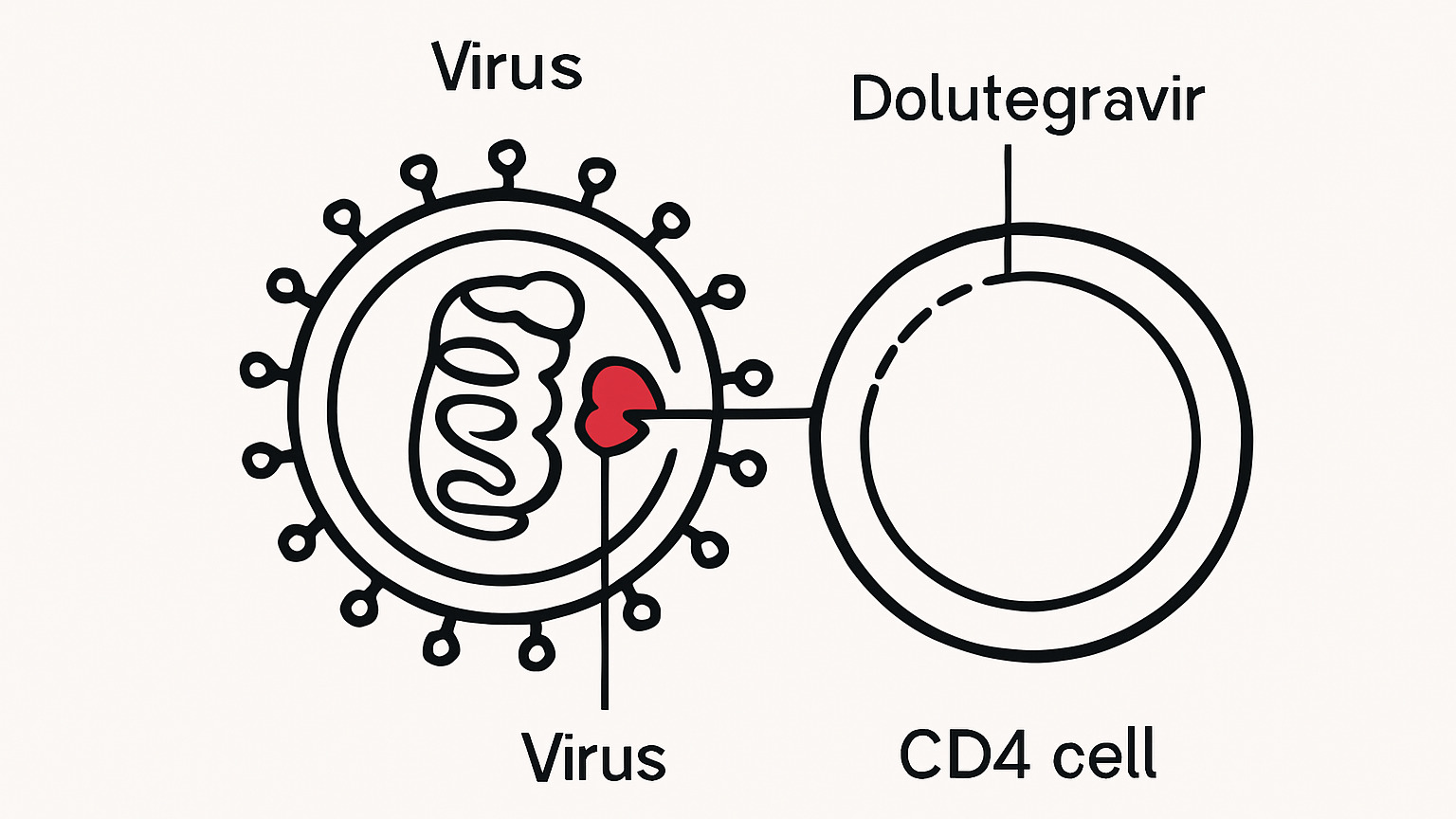
Dolutegravir has one of the largest and most consistent trial programmes of any antiretroviral, and one episode where an early safety signal changed practice before better data changed it back.
What did the registration trials show?
Studies including SPRING, SINGLE and FLAMINGO compared dolutegravir against raltegravir, efavirenz and boosted darunavir respectively. It matched or outperformed each on viral suppression, largely because fewer people discontinued it.
What did they show on resistance?
Remarkably little of it. Across the first-line programme, treatment-emergent resistance to dolutegravir was essentially absent, which is unusual and is the basis for describing its barrier as high.
What about treatment-experienced people?
The SAILING and VIKING studies examined it in people with resistance to other classes, including earlier integrase inhibitors. It retained activity against many raltegravir-resistant viruses, particularly at twice-daily dosing, which established its role in salvage regimens.
What did GEMINI establish?
That dolutegravir with lamivudine alone maintains suppression as effectively as three-drug regimens in suitable people starting treatment. This was a significant shift, opening the way to two-drug therapy and reducing long-term drug exposure.
What was the pregnancy signal?
A surveillance study in Botswana, Tsepamo, reported a higher than expected rate of neural tube defects among babies conceived while the mother was taking dolutegravir. The finding was based on a small number of cases and prompted immediate caution.
What happened next?
As more births were recorded, the excess narrowed substantially and fell close to background rates. Guidance was revised, and dolutegravir is now recommended in pregnancy and for people who may become pregnant.
Why is that episode worth knowing?
Because it illustrates how early signals from small numbers can be misleading, and because some people were switched away from an excellent drug on the basis of it. If you were moved for that reason, it is reasonable to ask whether the original regimen still suits you.
What about neuropsychiatric effects?
Trial rates were low, and real-world cohort reporting has been substantially higher, particularly for insomnia and mood changes. The discrepancy is a recognised pattern and probably reflects how side effects are collected rather than a contradiction.
What about weight gain?
Consistently observed across integrase inhibitor studies, more pronounced in combination with tenofovir alafenamide. Analyses have tried to separate a drug effect from return to health after starting treatment without fully resolving it.
What about metabolic effects more broadly?
Lipids are generally better on dolutegravir than on efavirenz or boosted protease inhibitors. The weight question and the lipid question point in different directions, which is why the overall metabolic picture is still debated.
What does real-world data show?
Very high rates of suppression and low discontinuation, consistent with the trials. It is now the backbone of treatment programmes across much of the world, which has produced an enormous body of observational data.
Has resistance emerged in practice?
Rarely, and more often than the first-line trials suggested, particularly in settings where people were switched onto it without resistance testing. It remains uncommon.
What is still being studied?
Long-term metabolic outcomes, use in further simplified regimens, and its role alongside long-acting agents. None of these is likely to displace it from first-line use.
Where can you read the evidence yourself?
NAM aidsmap summarises HIV research reliably, and the British HIV Association publishes the guidelines UK clinicians follow. Both are freely available and considerably more useful than a general search.
How should you read a headline about it?
Carefully. Reports about antiretrovirals often describe single studies, early findings or practice in other countries. Checking a claim against NAM aidsmap, or asking your clinic, is quicker than assessing the study design yourself.
Do guidelines change quickly?
Deliberately slowly. Recommendations shift when several studies point the same way rather than after one result. If something you read about dolutegravir seems to contradict what you were told, ask before acting on it.
What has not been established?
Outcomes over several decades, in most cases, simply because the follow-up does not yet exist. That is a reason monitoring continues rather than a warning, and it applies to almost every modern antiretroviral.


