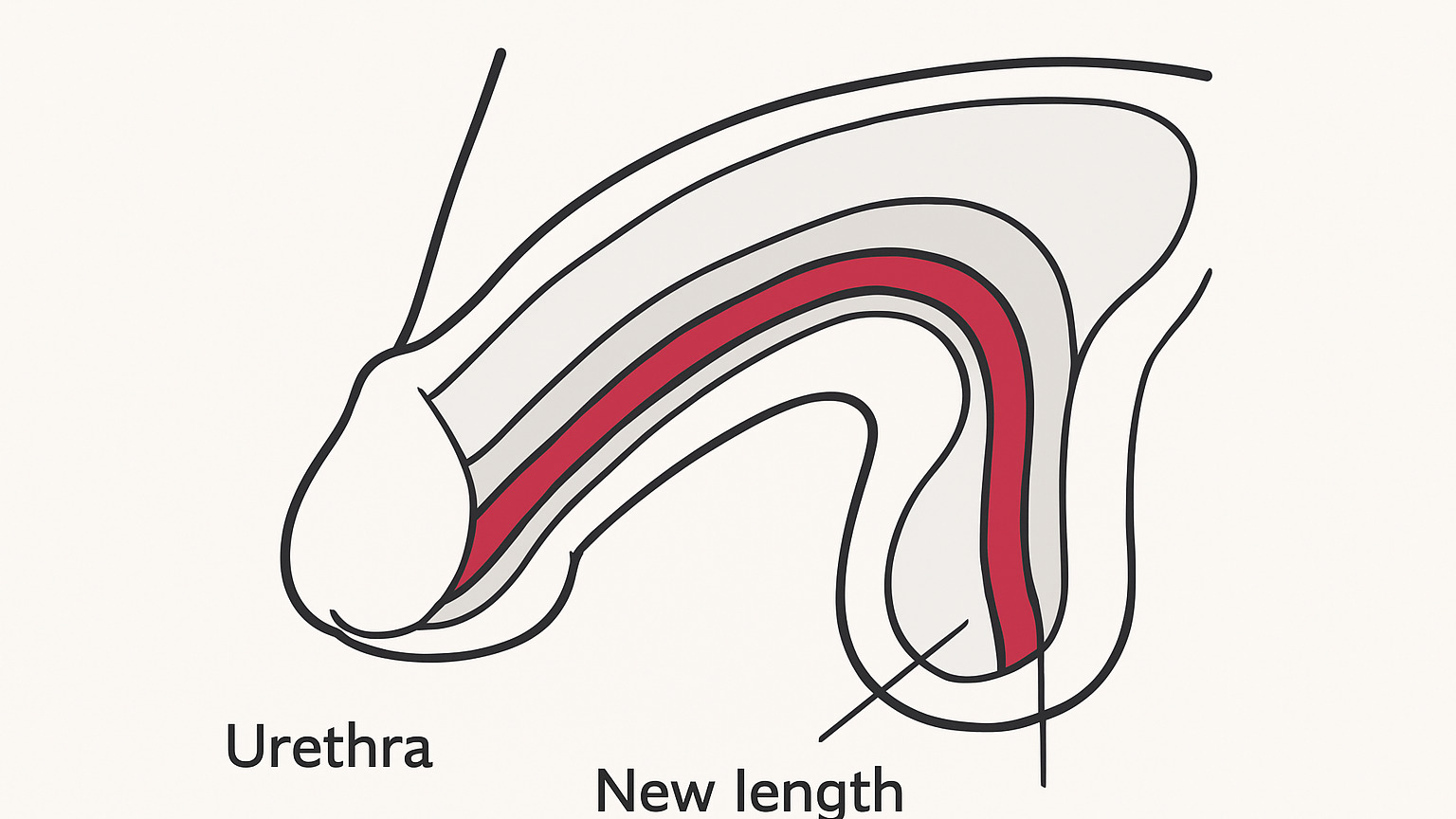
These are different operations with a shared set of considerations. Metoidioplasty releases and uses existing tissue; phalloplasty constructs using a graft from elsewhere. What matters most for sexual health afterwards is whether the urethra was lengthened, since that is where most complications occur.
What does urethral lengthening change?
It allows urinating standing and it introduces a longer, surgically constructed urethra with joins in it. Strictures, where the channel narrows, and fistulas, where an opening forms in the wrong place, are the two common complications. Both are well recognised, both are fixable, and both frequently need further surgery.
What are the warning signs?
A weakening or splitting stream, straining, taking longer, a sense of not emptying, or urine appearing from somewhere other than the tip. Recurrent urinary infections can also indicate a stricture. None of these should be lived with; they are worth raising with your surgical team promptly, since strictures worsen.
How does testing change?
A urine sample covers the urethra, as it would for anyone. If you still have a front hole, and use it for sex, it needs its own swab. Throat and rectal swabs apply as they would otherwise. Tell the clinic what surgery you have had so the right sites are sampled rather than guessed at.
What about urinary infections?
More common after urethral lengthening, and worth distinguishing from a sexually transmitted infection, since burning on passing urine could be either. A clinic can test for both from the same sample. Repeated infections are a reason to be assessed for a stricture rather than simply treated again.
What about sensation?
Returns gradually and unevenly over months to a couple of years, depending on technique and on nerve hook-up. Metoidioplasty generally retains erogenous sensation since it uses existing tissue. In phalloplasty, sensation develops progressively and varies considerably between people. Expectations set at twelve months are more accurate than at three.
What about erections?
Neither procedure produces a spontaneous erection. Options include external devices, rods or an inflatable implant, usually fitted at a later stage once sensation has returned. Implants carry their own risks including infection and mechanical failure, and your surgical team will go through the trade-offs.
What about the donor site?
Usually the forearm or thigh, and it leaves a permanent graft site that needs its own aftercare. It is worth factoring into how you feel about being seen, which is a real part of the sexual recovery and is rarely discussed.
When can you have sex again?
Your surgical team decides, and it is generally a matter of months rather than weeks, longer where an implant is involved. Starting before healing is complete risks the urethral repair in particular. Ask for a specific answer rather than working from what you have read.
Does any of this change prevention?
Not fundamentally. PrEP works the same way, daily dosing is the recommendation, and there is no interaction with testosterone. Condoms can be used with phalloplasty, including over an implant. If you still have a front hole and use it, the seven-day lead-in for PrEP applies.
What about fertility?
Neither procedure removes the ovaries or uterus by itself. If those remain and you have sex that could cause pregnancy, contraception is still relevant, and testosterone is not contraception.
Who do you ask about what?
Surgical team for anything structural, urological or healing-related. Sexual health clinic for infections, PrEP and screening. The two do not always talk to each other, so tell each what the other is doing.
What about before surgery?
Sorting out screening, PrEP and vaccinations beforehand is worth doing, since the months around surgery are not when anyone wants to be arranging a hepatitis course. Surgical teams also want to know about any current infection.
Is the recovery emotional as well?
Frequently, and it is under-discussed. Waiting for sensation, adjusting to a donor site and managing complications over a long period all take something. Peer support from people further along is more useful than most professional reassurance.